
A first-timer’s guide to Morocco’s most essential journey — from the Atlantic coast to the Sahara and beyond
Most people planning their first trip to Morocco ask the wrong question.
“How much can I see in seven days?”
The better question is: “What should I experience in seven days?”
Because Morocco is not the kind of country that rewards rushing.
It’s a country of long conversations over mint tea. Of mountain roads that deserve a photo stop every few kilometres. Of medinas where getting lost often leads to your favourite memory of the entire trip.
I’ve spoken to countless first-time visitors both before and after their Moroccan adventures. Many arrive with ambitious plans to squeeze Casablanca, Chefchaouen, Fes, the Sahara, Marrakech, Essaouira, and the Atlas Mountains into a single week.
On paper, it looks possible. In practice, it means spending more time chasing destinations than experiencing them.
After years of travelling Morocco deeply, across multiple seasons, along different routes, through cities, desert and mountain alike, there is one seven day route I come back to each time someone asks me where to begin.
The trips people remember most aren’t the ones where they see the most places. They’re the ones where they experience the right places deeply enough that those places stay with them.
Starting in Casablanca and ending in Marrakech, this route takes you through imperial cities, Roman ruins, cedar forests, ancient kasbahs, the Sahara Desert and the High Atlas Mountains. More importantly, it introduces you to Morocco in a way that keeps people coming back.
Why This Is the Perfect First-Time Morocco Route
Morocco is extraordinarily diverse. Within a single week, you can stand beside the Atlantic Ocean, wander through a thousand-year-old medina, sleep beneath desert stars, and cross mountain passes that look like they belong on another continent entirely.
The challenge isn’t finding things to do. The challenge is choosing what not to do.
This route focuses on the experiences that first-time visitors consistently treasure the most. You’ll move through:
|
Casablanca & Rabat |
The Atlantic coast and a composed, underrated capital |
|
Volubilis |
North Africa’s finest Roman ruins |
|
Fes |
One of the world’s most immersive medieval cities |
|
The Sahara Desert |
A night you will never forget |
|
Todra Gorge & Dades Valley |
Dramatic canyon country |
|
Ait Ben Haddou |
Morocco’s most cinematic landmark |
|
Marrakech |
The city that brings it all together |
The Route at a Glance
Day 1: Casablanca and Rabat
Day 2: Rabat, Volubilis, Meknes, and Fes
Day 3: Explore Fes
Day 4: Fes to the Sahara Desert
Day 5: Sahara Desert to Dades Valley
Day 6: Dades Valley to Marrakech via Ait Ben Haddou
Day 7: Explore Marrakech
Day 1 Casablanca to Rabat – Morocco’s Gentle Opening
Most travellers arrive in Casablanca expecting it to be Morocco’s main attraction. What they quickly discover is that Casablanca is more of an opening chapter than a destination, like a warm-up, not the headline act.
But what an opening chapter it is.
Begin with the Hassan II Mosque, one of the most extraordinary pieces of architecture anywhere in the world. It rises dramatically above the Atlantic Ocean, its minaret visible from miles away. The craftsmanship is breathtaking. The scale is difficult to comprehend until you’re standing directly beneath it, watching the ocean crash against the stones below.
After visiting the mosque, continue north to Rabat. If Marrakech is Morocco’s heartbeat, Rabat is its calm and collected older sibling. The capital feels organised, unhurried, and refreshingly understated, a city that doesn’t need to prove itself.
Spend the afternoon wandering through the Kasbah of the Udayas, where blue and white alleyways overlook the Atlantic. Visit Hassan Tower and watch your first Moroccan sunset along the coastline.
It’s a gentle, generous introduction to a country that will show you many faces over the days ahead.
🌙 Overnight: Rabat
Day 2 Roman Ruins, Imperial History & Arrival in Fes
Today reveals something most first-time visitors never expect to find in Morocco; Roman ruins.
Leaving Rabat behind, the road leads to Volubilis, one of the best preserved Roman archaeological sites in all of North Africa. Ancient columns rise from rolling green hills. Intricate floor mosaics remain remarkably intact two thousand years on. The views across the surrounding countryside are spectacular. It’s a reminder that Morocco’s history extends far beyond what most travellers have imagined before arriving.
A short drive away lies Meknes, one of Morocco’s four imperial cities. Often overshadowed by Marrakech and Fes, Meknes rewards the traveller who stops with grand gateways, ancient granaries, and a medina that feels genuinely unhurried.
By late afternoon, you arrive in Fes. As the evening call to prayer drifts across the rooftops, you’ll catch your first glimpse of a medina that has been fascinating travellers for centuries.
Tomorrow, you’ll understand why.
🌙 Overnight: Fes
Day 3 Getting Wonderfully Lost in Fes
There are cities you visit. And then there are cities you experience. Fes belongs firmly in the second category.
The medina of Fes is one of the largest car free urban areas in the world — a labyrinth of alleyways, hidden courtyards, ancient workshops and markets that seem genuinely untouched by the 21st century. This is where Morocco’s cultural soul reveals itself most completely.
A guided walk through the medina takes you past ancient madrasas (theological schools) adorned with breathtaking tilework and carved wood, into the famous tanneries where leather has been dyed using the same methods for centuries, and through artisan quarters where craftsmen continue skills passed down through generations.
Don’t worry about getting lost. Everyone does and somehow, that’s part of the magic. The best moments in Fes aren’t planned but discovered. A hidden courtyard behind an unmarked door. A tiny bakery with bread still warm from a wood fired oven. A craftsman working quietly in a room you nearly walked past.
The afternoon is yours, you may wander, explore, eat something from a stall you can’t quite identify, and let Fes work on you at its own pace. This is a city that rewards curiosity more than any other in Morocco.
🌙 Overnight: Fes
Day 4 The Day You Meet the Sahara
This is the day many first time visitors have been anticipating since they first opened a map of Morocco. It’s also, almost without exception, the day that surprises them most.
Leaving Fes behind, the landscape begins an extraordinary sequence of transformations. The alpine-style town of Ifrane feels almost European. The cedar forests near Azrou are home to Barbary macaques that peer at you from the tree branches with complete indifference. Rolling hills give way to rocky plateaus. The colours change. The sky feels wider. The horizon becomes harder to locate.
The reaction I hear most from first time visitors as the day unfolds is: “I had no idea Morocco looked like this.”
And then the dunes appear. That first glimpse of Erg Chebbi on the horizon is genuinely difficult to describe. Not because it’s dramatic in a cinematic way. Because it’s vast. Photographs never capture the scale. You simply have to be there.
As the sun drops lower, you ride camels into the dunes as the light shifts from gold to amber to deep orange. That evening is spent in a desert camp beneath a sky dense with stars. No traffic. No city lights. No notifications. Just silence, and the particular peace of being very far from everything ordinary.
For many travellers, this becomes the defining memory of their entire Morocco trip. I believe them every time.
🌙 Overnight: Sahara Desert Camp
Day 5 Sahara Sunrise, Canyon Walls & Ancient Valleys
If there is one morning worth setting an alarm for, it’s this one.
Watching the sun rise over the Sahara is an experience that stays with people long after Morocco has become a memory. The colours shift from deep violet to pale gold to something luminous and warm that photographs simply cannot hold. Climb a nearby dune before dawn and wait. You’ll understand why people come back to the desert again and again.
After breakfast, the journey continues towards the Dades Valley. The route passes through traditional Berber villages, palm filled oases and the spectacular Todra Gorge where canyon walls rise hundreds of metres above the valley floor, creating one of Morocco’s most jaw dropping natural landscapes. It’s the kind of place that makes you stop mid-conversation and just look.
This region is sometimes called the Valley of a Thousand Kasbahs, and as you travel through it, the name makes complete sense. Ancient fortresses appear on hillsides. Palm groves stretch across the valley floor. The scenery feels almost cinematic.
🌙 Overnight: Dades Valley
Day 6 Ait Ben Haddou & the Road Over the Atlas to Marrakech
Today combines some of Morocco’s most iconic scenery into a single extraordinary day on the road.
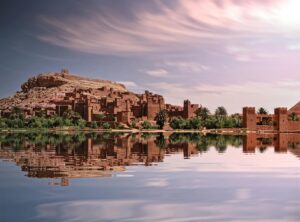
The first major stop is Ait Ben Haddou. Even if you’ve never heard the name, there’s a good chance you’ve seen it. This UNESCO World Heritage Site has appeared in productions ranging from Gladiator to Game of Thrones to Lawrence of Arabia. Built from earthen clay and rising naturally from the surrounding desert landscape, it feels both ancient and completely alive. A guided walk through its narrow streets and crumbling fortifications is genuinely atmospheric.
From here, the journey crosses the High Atlas Mountains via the Tizi n’Tichka Pass, Morocco’s most dramatic mountain road. Berber villages cling to slopes that seem too steep to support them. Deep valleys stretch toward distant horizons. Every turn produces another view that makes you want to stop the car.
By evening, you arrive in Marrakech. After days spent crossing mountains, valleys, and desert, the city’s energy hits you immediately. The sounds of Jemaa el-Fnaa. The scent of spices. The rhythm of the medina. It’s a fitting re-entry into the world after the silence of the south.
🌙 Overnight: Marrakech
Day 7 Marrakech – Morocco’s Glorious Final Act
No first trip to Morocco is complete without giving Marrakech the time it deserves.
The city is chaotic. Colourful. Fascinating. Occasionally overwhelming and completely, stubbornly unforgettable.
Spend the morning with a local guide walking through the souks, where artisans continue traditions passed down through generations. Leather workers. Weavers. Metalworkers. Spice merchants whose displays look like living paintings. Stop for mint tea on a rooftop overlooking the medina and watch the city move beneath you.
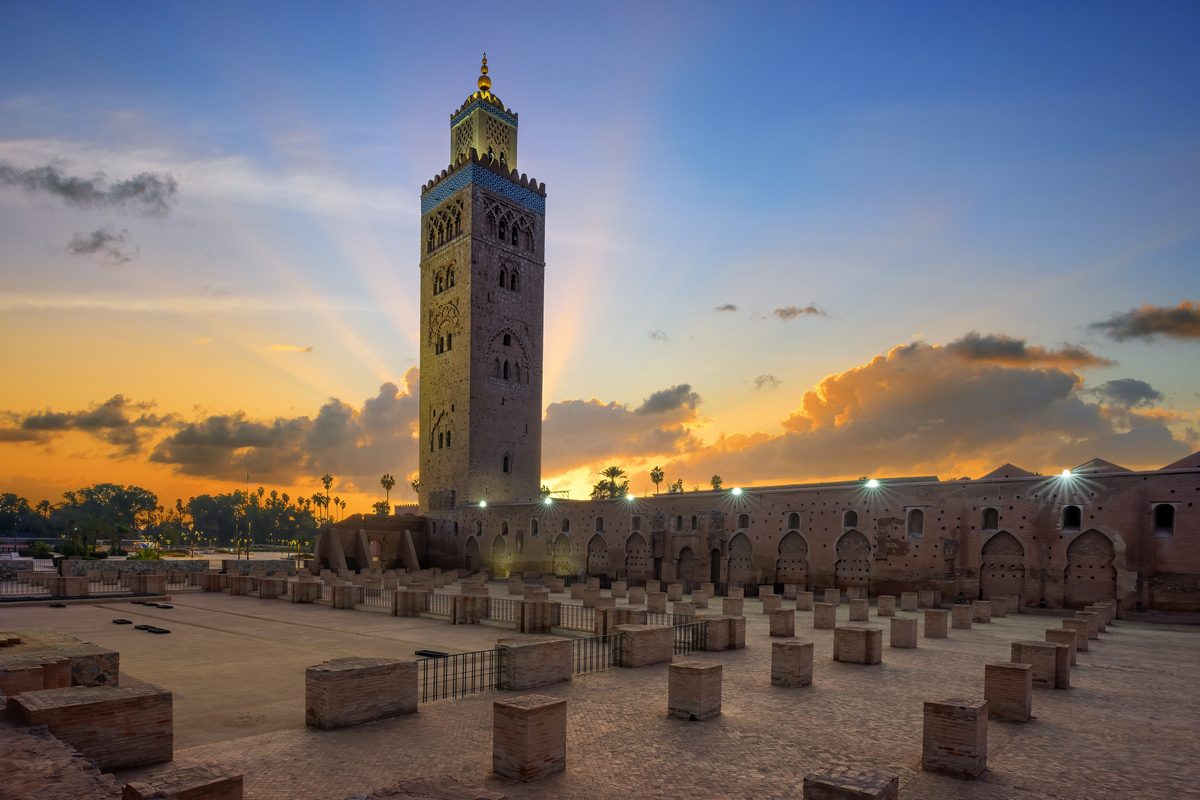
The afternoon reveals Marrakech’s quieter pleasures: the extraordinary Bahia Palace with its carved ceilings and shaded courtyards, the vivid Majorelle Garden (an unexpected oasis of blue), and the elegant Koutoubia Mosque whose minaret has anchored this city’s skyline for eight hundred years.
As evening arrives, make your way back to Jemaa el-Fnaa one final time. Food stalls assemble. Musicians gather. Storytellers, snake charmers, and henna artists take their positions. The square becomes a theatre with no stage and no assigned seats, just life, performing itself.
It’s the perfect ending to a week that has taken you from the Atlantic Ocean to the edge of the Sahara, through ancient cities and mountain passes that have carried travellers for centuries. Morocco doesn’t end here. It simply gives you your first reason to return.
🌙 Overnight: Marrakech
Is Seven Days Enough in Morocco?
Seven days is enough to fall in love with Morocco.
It’s enough to wander through ancient cities, cross mountain ranges, sleep beneath the stars in the Sahara, eat food you’ll be trying to recreate for years and understand, why so many travellers return.
But it isn’t enough to see everything.
And that’s perfectly fine. Morocco isn’t a destination to complete. It’s a destination to keep discovering. Every trip reveals a different face of the same extraordinary country. The blue city of Chefchaouen. The Atlantic coast of Essaouira. The remote villages of the Anti-Atlas. The ancient streets of Meknes.
Seven days, done well, leaves you with something more valuable than a completed checklist: a deep appetite to come back.
A Little Note, Before You Visit
First time Morocco trips have a particular quality that I’ve never quite found anywhere else.
They start as a journey through a country. They tend to end as a journey through yourself.
Morocco has a way of disorienting you gently, pulling you out of your routines, your habits, your usual way of moving through the world and then showing you something quieter and more essential underneath. Whether that happens in the silence of the Sahara, in a conversation over mint tea with someone you’ve just met, or simply in the feeling of being completely lost in a medina with nowhere urgent to be.
What I’d tell anyone planning their first trip: resist the urge to see everything. Choose depth over distance. Give each place enough time to reveal itself. The itinerary above isn’t about covering ground efficiently, it’s about arriving in each place with enough presence to actually feel it.
That’s when Morocco stops being a destination and starts being an experience you carry home with you.
Final Thoughts
A first trip to Morocco should leave you inspired, not exhausted.
It should introduce you to the country’s incredible diversity without making you feel as though you’ve sprinted through it. This seven day route does exactly that.
From the Atlantic coast to the Sahara Desert. From Roman ruins to ancient medinas. From mountain passes carved by centuries of travel to the electric, joyful chaos of Marrakech at dusk.
It captures the essence of Morocco in a way that few itineraries manage. And if the pattern holds true and it almost always does, seven days will be precisely enough for one thing.
Making you want to come back.