
Over centuries, Arab, European, and Berber influences have combined to create one of the world’s most exotic yet accessible destinations. Located just a few hours from major European cities, Morocco offers deserts, beaches, lush oases, and ancient cities with labyrinthine medinas.
While many travellers flock to Marrakech and Fes to soak up North African creativity and culture, I’d steer you straight into the desert for something genuinely, irreversibly life-changing. With its breathtaking landscapes, fascinating indigenous culture, extraordinary handicrafts, and accommodations that have no business being that beautiful in the middle of nowhere is a trip to the Sahara, which is not optional but a must.
Merzouga and the Erg Chebbi dunes aren’t just a destination. They’re a reminder that the world is still vast and wild and full of things that no screen can replicate.
We spent an afternoon cooking with a warm and gracious Berber family, one of those experiences that only happen when you’re in the right place with the right people around you. We were welcomed into their home, and it’s something I will hold close to my heart for the rest of my life.
Later came the camel trek over the dunes, a sunset that seemed personally designed to make you feel something, and memories I’m still not done processing.
From visiting nomads behind the dunes of Erg Chebbi and sipping tea under traditional tents, to quad biking over the sand and stumbling into Khamlia village for live Gnawa music and believe me, every single moment was worth it. Every single one.
If you’re ready to be enchanted by Morocco’s exotic spices, mystical sites, and ancient traditions, it’s time to stop scrolling and start packing. You will not regret this.
A Little Backstory
As a child, I spent the first 14 years of my life in the eastern part of India. My only real knowledge of deserts came from movies and books, until my first trip west within India, where I visited the Thar Desert; the Great Indian Desert. Over time, I grew to appreciate the unique, vast beauty of that landscape, though to be honest, it was never quite my ideal holiday setting.
So when people told me Morocco’s desert would be something else entirely, I listened politely and assumed they were exaggerating.
Spoiler: they were not.
Most Morocco bucket lists include the famous cities, the iconic photo ops, and the usual activities like shopping in the medinas, staying in a stunning riad, eating tagine, and figuring out how to fit a camel-wool rug into your carry-on. You should absolutely do all of those things.
But please, do not leave Morocco without a night in the Sahara Desert. Here’s why.
01 The Views: These Sand Dunes Will Undo You
Let’s start with the obvious, the iconic golden dunes of the Sahara.
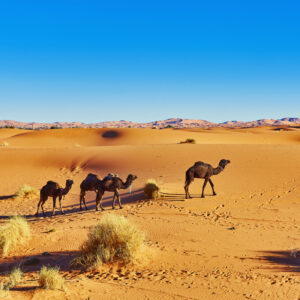
The vast, impossibly quiet landscapes. A silence so deep you can actually hear your own heartbeat. An empty horizon of soft rolling sand, occasionally interrupted by a camel caravan, a black raven, or a fluffy owl darting across the blue sky. It’s a scene of yellow against blue that looks like a painting, except no painting has ever quite got it right.
Anyone who doesn’t believe in love at first sight hasn’t been to the Sahara Desert.
Having grown up with the Thar Desert as my mental benchmark, I genuinely wasn’t prepared for what Erg Chebbi delivered.
At sunrise, the sand is pale pink in the not-yet-morning light, soft and cool underfoot. Slowly, the sun climbs overhead, blazing hotter and brighter, casting deep shadows that trace the crests of the fiery gold dunes.
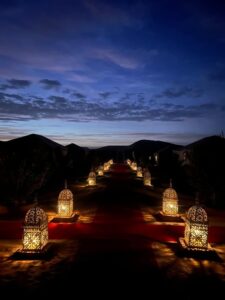
By nightfall, if you’re lucky (on this trip you will be), the giant African sun sinks behind the hazy horizon, painting the sky in colours you wouldn’t believe could exist in nature. Then, in an instant, the sky turns black. And the stars appear. Billions of them, with the Milky Way stretching unobstructed from one edge of the sky to the other. The only other light nearby comes from a small candlelit lantern guiding you back to your tent.
There is no better way to fall head over heels for this planet. Don’t miss it.
02 The Culture: Life Lessons from the Berber ‘Free People’
Believe it or not, more than two million people still inhabit the Sahara Desert. In Morocco, the Berbers were among the earliest inhabitants of the desert, with origins dating back to around 3000 BC. Many still continue the same nomadic way of life as their ancestors, moving across the desert in search of water.
Although “Berber” is the more widely recognised term, the indigenous people prefer to be called Amazigh (amazee) meaning “free people.” This term carries deeply bittersweet significance.
Until the 1960s, no real country borders existed in the Sahara Desert, allowing the Amazigh to move freely across the land. With the end of colonisation and rising territorial tensions, lines were literally drawn in the sand. Families were divided between Morocco and Algeria overnight. The sense of loss from that rupture is still felt today.
But the “free people” identity goes far deeper than resisting geopolitical borders. The Amazigh believe in not dividing people based on religion, ethnicity, gender, or economic status. It isn’t just a phrase, it’s a way of life that brings a deep, tangible sense of acceptance and unity into every corner of their society.
What struck me most was the role of women in Amazigh culture. They aren’t just the guardians of identity but also the ones who carry traditions, language, and memory forward through generations. Spending time with the women of a Berber household in the desert was one of the most quietly powerful experiences of my entire trip. The warmth. The simplicity. The love in that space.
I’ll never forget it.
Berber courtship customs known as Takerfiyt are another fascinating thread. Social anthropologists have identified them as one of the most intentional and successful systems for building a life partnership anywhere in the world. The man and woman follow a schedule of daily meetings, asking questions, discussing their future, building trust gradually. Ninety-nine percent of the decision belongs to the couple. The remaining one percent involves gentle family guidance. It’s a process built entirely on respect and honestly, the rest of the world could learn from it.
03 The Accommodations: Live Like Sahara Royalty
Despite intensely limited resources and foundations that literally shift with the wind, the Sahara Desert is home to some of the most extraordinary accommodations on the planet.
Your two main options are a desert auberge (a bed & breakfast) or a desert camp. I chose the camp, and I have not stopped talking about it since.
Option A: Desert Camp (Glamping)
Most visitors choose to stay in a desert camp with tented rooms, but be warned that lower-cost camps will correlate with more “rugged” living conditions. Considering there’s about a 50% chance you’ll face a sandstorm while out in the desert wilderness, you might want to save the “rugged” for another time.
My suggestion: splurge on luxury. You’re in the Sahara once. Do it properly.
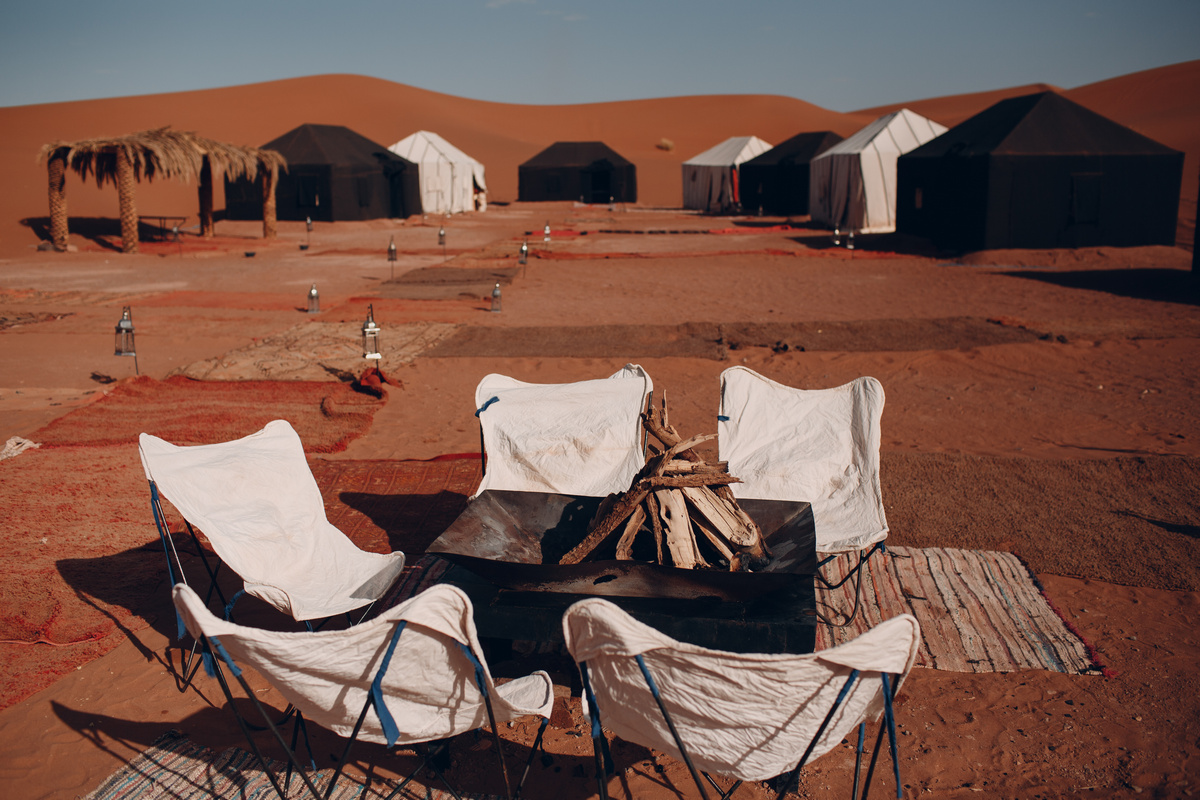
Picture arriving at your camp after an exhilarating 4×4 ride over the dunes. The camp is decorated with colourful Moroccan rugs, carved wood furniture, and white-draped tents arranged beautifully across the sand. A home-cooked dinner is served beneath the stars. As the sky darkens, you settle onto a giant camel-wool pouf around a bonfire, belly full, being lulled by the sound of Berber drums and the occasional groan of a nearby camel.
When it’s time to sleep, a lantern-lit path leads you back to a tent so luxurious it would make most city hotels question themselves.
There are so many luxury camps from which to choose, but I recommend Palmyra Luxury Camp. I had a perfect stay there and it’s stellar reviews can back me up.
04 The Fun: For the Adrenaline Seekers
Yes, I began this piece with a romantic ode to the dunes. But the desert has a second side entirely and it is absolutely here for the adrenaline junkies.
Few things are more thrilling than tearing across towering dunes on a quad bike with nothing to obstruct your path as far as the eye can see. The combination of speed, sand, and open sky is something else entirely.
Pro tip: Wear sunglasses. You will have sand in your face.
Or try strapping your feet into a sandboard and “surfing” down the dunes as though they were made of snow. They’re not. But the feeling is surprisingly similar and considerably warmer.
My recommendation? Try both. Then sit around the campfire, recover, and gear up to do it again tomorrow.
05 The Handicrafts: The Heart of Moroccan Creative Culture
The Berber people are among the most gifted artisans in the world. From rugs woven from camel hair and cactus silk to silver jewellery adorned with amber, coins, shells, and hand-blown glass, and even traditional hand-forged knives, every piece looks like it belongs in a museum. But more than that, every piece tells a story.
If you buy something here without learning its backstory, you’ve only taken home half the treasure. Ask. The people here love to explain. That’s part of the experience.
Music is inseparable from Berber culture. Legends, histories, and traditions are passed down verbally, which means music has always been the primary medium for memory and meaning. If you take the time to translate the lyrics of Berber folk songs, you’ll find stories about family, identity, war, and belonging. They are enchanting in a way that stays with you.
However, the Berbers aren’t the only group in the desert with international musical fame. The Gnawa, an ethnic group in Morocco and Algeria, is renowned for their hypnotic, trance-like music. Most notably, the Gnawa use these songs, marked by low-toned rhythmic patterns, in various spiritual and healing rituals. While you’re in the desert, you can visit the Gnawa community and experience a musical performance first hand. Be sure to bring some cash to show your support by leaving a tip!
The Logistics
Where to Go
The Sahara is enormous but don’t let that overwhelm you. For the first visit, Merzouga is the answer. It’s a small village near the Algerian border, famous for the Erg Chebbi dunes and a seasonal salt lake. It’s accessible, well-equipped with accommodation options, and sits at the edge of one of the most photogenic stretches of desert anywhere on Earth.
The legend: Moroccan folklore says the Erg Chebbi dunes were sent as a divine punishment after a wealthy family refused hospitality to a poor woman. God buried them under sand. Those dunes now tower over the village of Merzouga, a permanent reminder that in this part of the world, hospitality is sacred.
How to Get There
It’s approximately an 8-hour drive from Marrakech to Merzouga. You’ll want an experienced driver who knows the roads and the desert, a proper 4×4 for the final stretch through the dunes, and ideally a playlist that does justice to the scenery.
The final approach to your camp is a 30 to 45 minute 4×4 ride through the dunes themselves, an adrenaline moment in its own right. You’ll arrive in the middle of nowhere, with nothing but sand in every direction, and the feeling that you’ve genuinely earned where you’ve ended up.
Booking Accommodation
The Sahara has a wide range of accommodation options, but this is genuinely not the place to chase the cheapest option available. A budget camp in the middle of the desert with inadequate food, unreliable drinking water, or a two hour camel ride just to reach the site is not the kind of story you want to be telling.
Unlike Marrakech, where switching riads if yours disappoints is relatively straightforward, in the desert you’re committed to your choice. Choose carefully. Read recent reviews. Book with confidence.
Pro tip: For the desert camp experience, I recommend booking through your guide or local contact rather than through online portals alone. Local knowledge makes a real difference here.
On Tour Guides
Do not navigate the Sahara alone. I say this with complete sincerity and here’s why.
Local guides have names for individual dunes. They can navigate in a sandstorm, know which flood paths are safe to cross, and can distinguish one dune from the next in a landscape where every direction looks identical. They will keep you safe in ways you won’t fully appreciate until you’re in it.
Then there are the storms. Sandstorms and even flash floods are possible in the Sahara, we experienced both while we were there. Our guide knew which flooded areas were safe to drive through and which would leave us stranded. He could probably have navigated the desert blindfolded, so sandstorms were no concern.
And you’d miss out on so much of the culture. If it weren’t for Sais’s background, experience, and love for his culture, I would have never learned as much as I did about Berber culture. It was his cultural insights and the activities he introduced us to that made us fall in love with our desert getaway.
I can’t recommend our on-ground travel partner, Deep Morocco Tours, enough. Said and our driver, Ibrahim, were not only a blast to travel with, but they were also so well-rooted to their cultures. Said is incredibly knowledgeable about the history, culture, accommodations, and activities. He helped us avoid tourist traps, find the best viewpoints for sunrise and sunset, and gave us the authentic Morocco experience we were looking for.
Let’s Go
Morocco is, without question, one of the most diverse and beautiful countries I have ever visited. The famous cities, the mosques, the markets, all of it is a must-see.
But leaving Morocco without visiting the Sahara would be a big miss!
I could have spent a week out there. Maybe a month. Even writing this is making me nostalgic for those three days in the desert, the silence, the stars, the sand, and the extraordinary generosity of the people who call it home.
Trust me, add the Sahara to your Morocco bucket list and you won’t regret it.